Tax strategy can influence student loan payments and forgiveness. Managing income, filing status, retirement contributions, and potential tax consequences can help borrowers reduce costs and build a smarter repayment strategy...
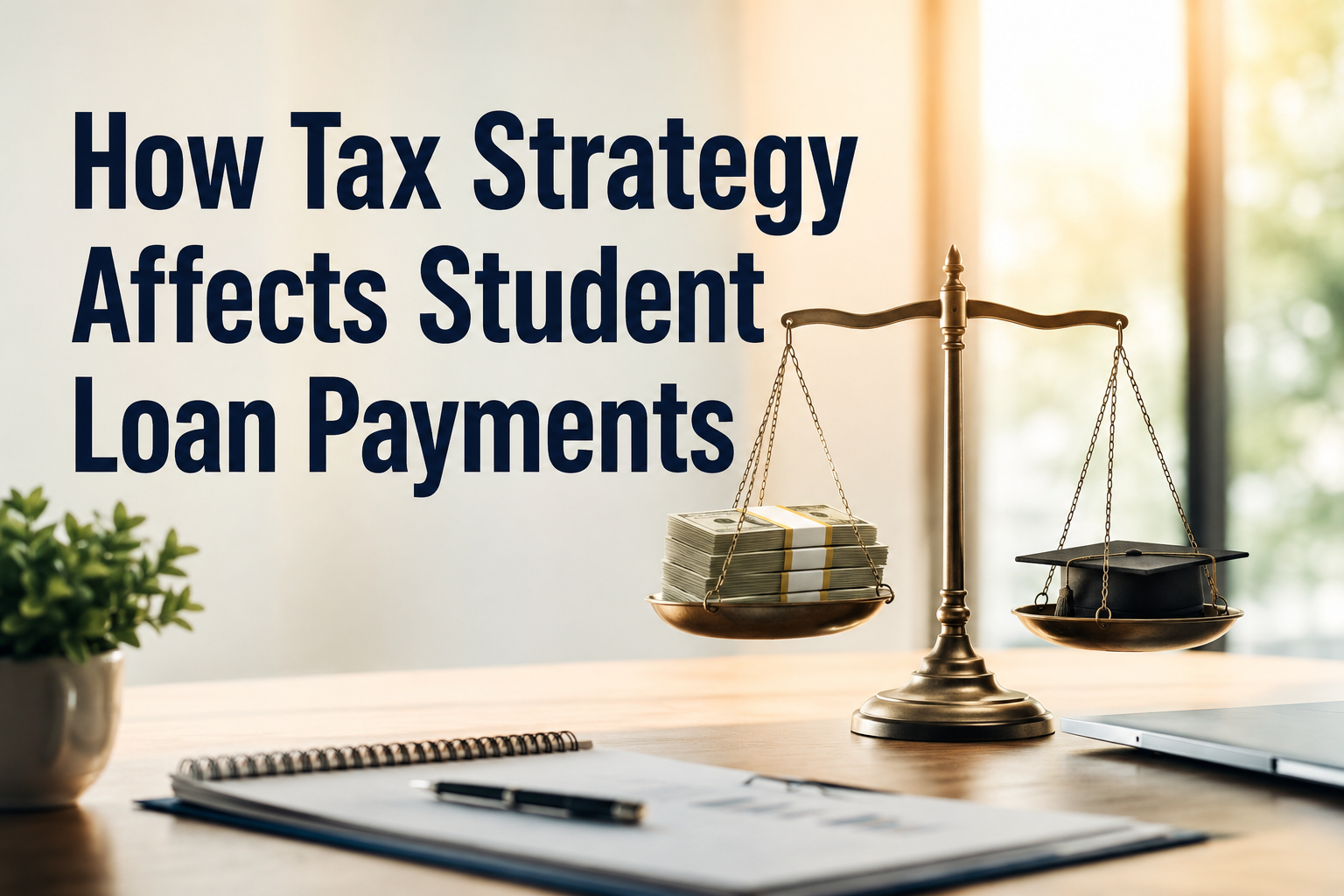
For borrowers pursuing student loan forgiveness, tax planning can affect much more than the amount owed to the IRS each year. Your tax return may also influence your required federal student loan payment, the amount you repay over time, and ultimately how much of your balance could remain for forgiveness.
This connection is especially important for borrowers using an income-driven repayment plan. Understanding how adjusted gross income, tax filing status, retirement contributions, and future forgiveness interact can help borrowers make better long-term decisions.
Income-driven repayment plans generally calculate monthly payments using income and family size. Federal Student Aid typically relies on federal tax information when determining a borrower's income.
That makes adjusted gross income, or AGI, an important number for many borrowers.
When AGI increases, an income-driven student loan payment may increase as well. When AGI decreases, the required payment may be lower, depending on the repayment plan and the borrower's circumstances.
This means tax planning and student loan planning should not always be treated as separate financial decisions.
For example, eligible pre-tax retirement contributions can reduce taxable income and potentially lower AGI. A lower AGI may also result in a lower income-driven student loan payment. Instead of simply looking at the immediate tax savings from a financial decision, borrowers pursuing student loan forgiveness should consider how that decision could affect their repayment calculation.
Tax filing status can have an especially significant impact on married borrowers.
Under most current income-driven repayment plans, borrowers who file married filing jointly generally have payments calculated using the couple's joint income. When both spouses have federal student loans, the payment calculation may account for each spouse's share of the couple's federal student loan debt.
Borrowers who file married filing separately will generally have only their individual income considered under current IDR rules.
That can create an opportunity for some households to reduce student loan payments. However, filing separately is not automatically the better choice.
Married filing separately can increase a household's tax liability and restrict access to certain tax deductions and credits. For example, married borrowers filing separately generally cannot claim the student loan interest deduction and may lose access to other tax benefits.
The correct comparison is therefore not simply:
Which filing status creates the lowest student loan payment?
A better question is:
Which filing status creates the best overall financial result after considering both taxes and student loan payments?
A household that saves $4,000 per year on student loan payments but pays $6,000 more in taxes may not actually be improving its financial position.
For borrowers pursuing long-term student loan forgiveness, lowering required payments can have a second benefit.
If a borrower is working toward forgiveness and makes smaller qualifying payments along the way, more of the loan balance may remain when the borrower eventually reaches forgiveness eligibility.
This is why strategies that reduce AGI can be particularly valuable for certain borrowers. Depending on individual circumstances, contributions to eligible pre-tax retirement accounts and other legitimate tax-planning strategies may simultaneously:
The benefit depends heavily on the borrower's repayment plan, income, loan balance, family situation, and forgiveness timeline.
Tax planning is also important at the end of the repayment process.
The temporary federal tax exemption that broadly covered qualifying student loan forgiveness from 2021 through 2025 has expired. Beginning in 2026, certain student loan balances forgiven through income-driven repayment may once again be treated as taxable cancellation-of-debt income at the federal level.
That means a borrower receiving substantial IDR forgiveness could potentially face a significant future tax bill.
There are important exceptions. Public Service Loan Forgiveness, commonly known as PSLF, remains federally tax-free. Certain other forms of student loan discharge and repayment assistance can also receive different tax treatment.
State taxation can vary as well.
Borrowers expecting substantial student loan forgiveness should therefore consider the potential tax consequences years before forgiveness occurs. Building savings gradually for a possible future tax liability can be far easier than trying to fund a large tax bill in a single year.
Federal student loan repayment rules have undergone significant changes, and additional transitions are already scheduled.
The federal Repayment Assistance Plan, or RAP, is now part of the income-driven repayment system. PAYE and ICR are scheduled to be eliminated, with affected borrowers required to transition to another repayment option by July 1, 2028. Eligibility can also depend on when a borrower's loans were disbursed.
Because of these changes, borrowers should avoid basing a long-term student loan forgiveness strategy on outdated payment formulas or assumptions.
A strategy that worked several years ago may no longer produce the same result today.
Tax strategy can be an important part of a successful student loan forgiveness plan. Adjusted gross income, retirement contributions, marital tax filing status, repayment-plan selection, and the potential taxation of future forgiveness can all influence the true cost of repaying federal student loans.
The goal should not simply be to minimize this year's tax bill or this month's student loan payment. The better approach is to evaluate taxes, student loan payments, forgiveness eligibility, and long-term financial goals together.
Student Loan Tutor helps borrowers evaluate these moving pieces as part of a personalized student loan strategy. Visit studentloantutor.com to learn how your tax decisions and repayment choices could affect your path toward student loan forgiveness.
The strategy outlined in this article is designed to help you save on federal student loans and work towards forgiveness. Please be aware that the federal student loan landscape is subject to change. Adjustments to this strategy may be necessary with evolving regulations and policies, and by working with us, you can be confident that you are leveraging expert guidance to ensure you are always on the best path to maximize your student loan forgiveness.The contents of this article are the property of Student Loan Tutor. This message may contain an advertisement of a product or service. Student Loan Tutor does not render legal, tax or accounting advice. Accordingly, you and your attorneys and accountants are ultimately responsible for determining the legal, tax and accounting consequences of any suggestions offered herein. We recommend that you consult with your legal and tax advisers regarding this communication. Student Loan Tutor is not affiliated in any way with the US Department of Education. The estimates contained herein are based on estimates derived from the studentaid.gov federal student loan repayment calculator, taking into consideration repayment plans, federal student loan forgiveness, and tax implications associated with current tax estimates using TurboTax percentages for 2025. Student Loan Tutor accepts no liability for estimates contained herein as a borrower's life circumstances, final submitted documents, student loan law subsidies, loan forgiveness and tax implications can change at any time without any notice and many of these strategies are only recently starting to be realized due to long loan forgiveness terms. A number of factors could drastically change these figures, including but not limited to the following: using forbearance or deferment, missing a recertification, changes in law including but not limited poverty line index, spousal income, income documentation protocol, repayment plans, public service loan forgiveness qualifications, tax law, household size, additional loans, consolidations, refinancing and the COVID-19 Pandemic.
Looking for more information about how to navigate the terrain of student loans? Check out more of our most recent blog posts.
October 5, 2026
Lower student loan payments can provide short-term relief but may increase long-term costs. Understanding interest, repayment length, forgiveness eligibility, income, and total repayment can help borrowers choose strategically...

September 28, 2026
This article explores strategies for managing student loan debt while pursuing long-term forgiveness, including repayment plans, PSLF, income changes, extra payments, administrative requirements, and evaluating overall long-term repayment costs...

September 21, 2026
Strategic student loan repayment can help borrowers avoid overpaying by considering repayment plans, forgiveness, income changes, taxes, interest, autopay benefits, and long-term financial goals before making additional payments...


