Your monthly payment is just the beginning. Discover how student loans shape your wealth, retirement, life milestones, and how to build a strategy that actually protects your future...
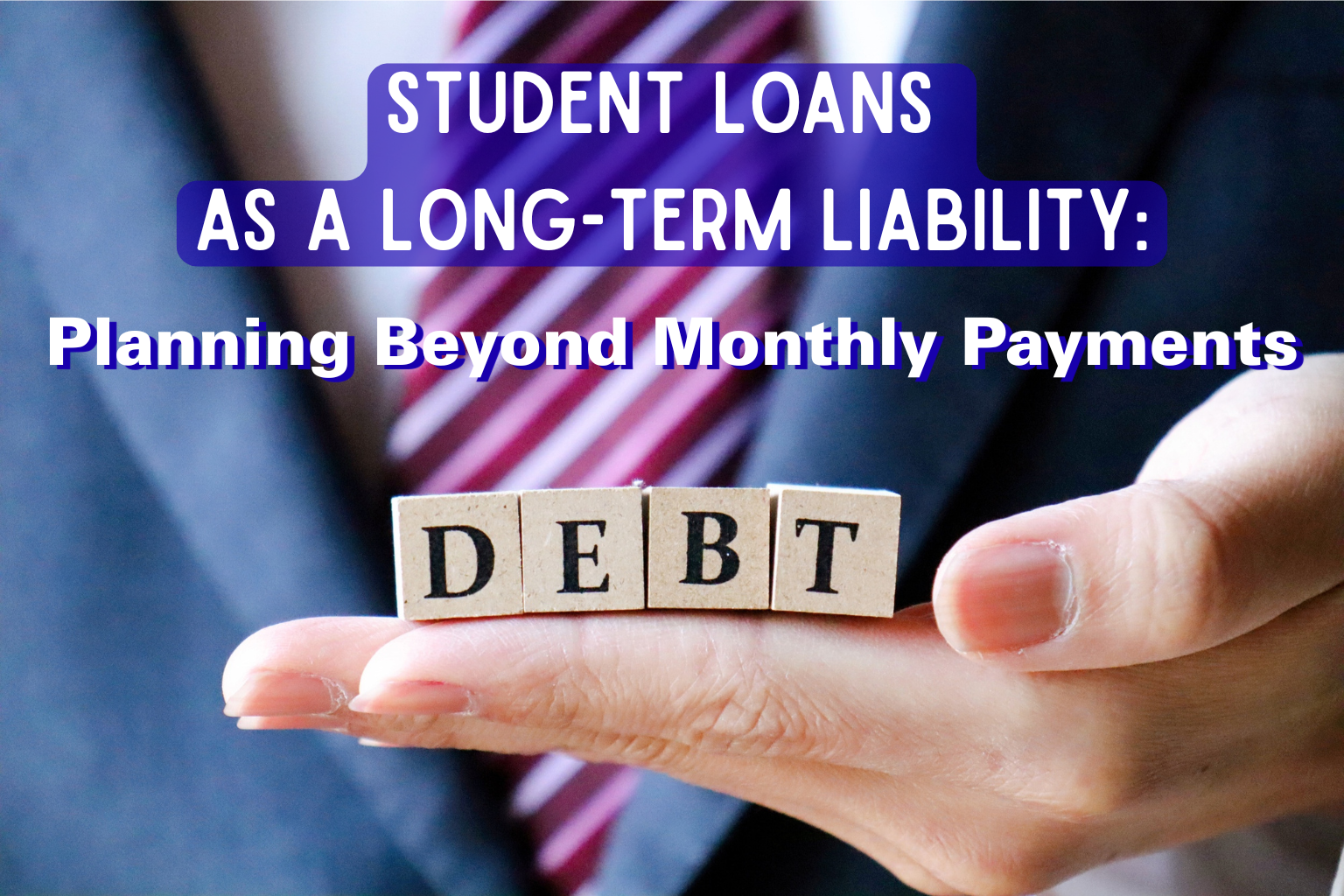
Most borrowers focus on one number: the monthly payment. It fits the budget, the autopay is set, and life moves on. But student loans are not just a recurring expense. They are a long-term liability, one that quietly shapes your financial future for years, sometimes decades, after graduation.
Understanding student loans as a liability, rather than simply a payment, changes everything about how you plan, save, invest, and build wealth. At Student Loan Tutor, we help borrowers see the full picture and take action accordingly.
In personal finance, a liability is any debt or financial obligation you owe. Unlike a mortgage, which is backed by an appreciating asset, student loans are unsecured debt, meaning they are not tied to anything you can sell to offset the balance.
A long-term liability carries three defining characteristics that borrowers often underestimate:
1. Interest compounds over time. Federal and private student loans accrue interest daily. If you are on an income-driven repayment (IDR) plan with a low payment, there is a strong chance your interest is growing faster than you are paying it down. This condition is known as negative amortization.
2. It affects your debt-to-income ratio. Lenders evaluate your student loan balance and monthly obligation when you apply for a mortgage, car loan, or business financing. A large student loan liability can limit your borrowing power for years.
3. It delays other financial milestones. Research consistently shows that student loan borrowers delay homeownership, retirement contributions, and family planning at higher rates than non-borrowers. These delays have compounding consequences of their own.
Let's say you graduated with $60,000 in federal student loans at a 6.5% interest rate on a standard 10-year repayment plan. Your monthly payment is approximately $681, and your total repayment over a decade is around $81,700, which is nearly $22,000 more than you borrowed.
Now consider income-driven repayment. If you extend that same $60,000 balance over 20 to 25 years at a lower monthly payment, your total paid could exceed $100,000, and that is before accounting for any forgiveness taxability at the end.
Understanding this math is the starting point of smart long-term planning. The question is not just "what is my monthly payment?" The question is: what is the total cost of this loan over its full lifetime, and how does that interact with my other financial goals?
Federal and private loans behave very differently. Federal loans offer income-driven repayment options, Public Service Loan Forgiveness (PSLF), and various deferment protections. Private loans offer none of those. They operate like any other consumer debt, with fixed terms and fewer safeguards.
Before you can plan, you need to know exactly what you have:
This information lives in your StudentAid.gov account for federal loans and with your private lender for private loans.
Your loan balance today is not the liability that matters most. What matters is the trajectory: where will that balance be in 5 years, 10 years, and at payoff or forgiveness?
Run a full repayment projection using the Federal Student Aid Loan Simulator at studentaid.gov/loan-simulator, or work with a student loan advisor to model your options. Key scenarios to compare:
Each pathway has a different total liability profile. Choosing without comparing them is one of the most common and costly mistakes borrowers make.
Student loans do not exist in a vacuum. They compete directly with other uses of your income: emergency savings, retirement contributions, down payments, and investment accounts.
The most common trap is optimizing the loan in isolation. A borrower might aggressively pay down their student loans while neglecting a 401(k) with a full employer match, effectively leaving free money on the table while chasing a 6% debt. A better approach balances both.
Here is a practical prioritization framework for most borrowers:
This order will shift depending on your income, loan type, employer benefits, and forgiveness eligibility. A personalized plan matters here, because generalizations only go so far.
Long-term liabilities do not exist in a static environment. Life changes, and your student loan strategy needs to change with it.
Marriage: If you file taxes jointly, your spouse's income is included in IDR payment calculations. This can significantly increase your monthly payment. Conversely, it may accelerate your path to forgiveness or make aggressive payoff more achievable. Married borrowers should always model both filing jointly and separately to find the optimal approach.
Homeownership: Mortgage lenders count your full student loan monthly payment against your debt-to-income ratio (DTI), even if your IDR payment is $0. If you are targeting homeownership, understanding how your loans affect your DTI and what adjustments to make is essential planning work before you apply.
Career Changes: Switching from a nonprofit to a private sector employer, or vice versa, can affect PSLF eligibility. Borrowers pursuing forgiveness should always verify their employer's qualifying status before accepting a new role.
Income Growth: A significant raise can push you out of IDR eligibility or dramatically increase your payment under income-sensitive plans. Model your payment at future income levels, not just current ones.
Family Planning: Having children changes your family size, which is used in IDR payment calculations and can lower your monthly payment. Understanding this dynamic can be a meaningful part of repayment planning.
Student loans carry a risk that most borrowers overlook entirely: what happens if you become unable to work?
Federal loans offer protections in this area, including deferment, forbearance, and in cases of permanent total disability, discharge. But private loans are far less forgiving, and many private lenders will continue collection even in the event of serious hardship.
Disability insurance is not just a retirement planning tool. It is a student loan risk management tool. Borrowers with high private loan balances, in particular, should evaluate income protection insurance as part of their overall financial plan.
Life insurance is also worth considering if a co-signer, typically a parent, is on private student loans. In the event of the borrower's death, private loans do not always discharge automatically. Federal loans do discharge upon the death of the borrower, but private lenders vary widely on this policy.
Perhaps the most important insight in long-term liability planning is this: doing nothing is still a decision, and it is often the most expensive one.
Borrowers who set their loans on autopay and stop thinking about them lose years of optimization. They miss refinancing windows when rates drop. They fail to certify employment for PSLF. They make extra payments on low-interest federal loans while carrying high-interest private debt. They contribute nothing to retirement for years while the market compounds for others.
Every year of delay is a year of lost wealth-building. Student loans are large enough, and long-lived enough, that strategic management of them is genuinely worth the effort.
A student loan advisor is not just for borrowers in crisis. The most valuable planning conversations happen early, before decisions are locked in.
Consider working with a certified student loan advisor if:
At Student Loan Tutor, our advisors are certified and work exclusively with student loan borrowers. We do not sell financial products or take commissions. We provide clear, personalized analysis of your loans, your options, and your path forward.
Monthly payments are where most borrowers start. Long-term planning is where financial outcomes are actually determined.
Student loans, managed strategically, do not have to derail your financial life. But treated as an afterthought, as just another bill, they absolutely can. The difference between the two outcomes is not income, luck, or financial expertise. It is intention, information, and a plan that looks beyond this month's payment.
Start building that plan today. Visit StudentLoanTutor.com to speak with a certified advisor and take control of your student loan liability for good.
The strategy outlined in this article is designed to help you save on federal student loans and work towards forgiveness. Please be aware that the federal student loan landscape is subject to change. Adjustments to this strategy may be necessary with evolving regulations and policies, and by working with us, you can be confident that you are leveraging expert guidance to ensure you are always on the best path to maximize your student loan forgiveness.The contents of this article are the property of Student Loan Tutor. This message may contain an advertisement of a product or service. Student Loan Tutor does not render legal, tax or accounting advice. Accordingly, you and your attorneys and accountants are ultimately responsible for determining the legal, tax and accounting consequences of any suggestions offered herein. We recommend that you consult with your legal and tax advisers regarding this communication. Student Loan Tutor is not affiliated in any way with the US Department of Education. The estimates contained herein are based on estimates derived from the studentaid.gov federal student loan repayment calculator, taking into consideration repayment plans, federal student loan forgiveness, and tax implications associated with current tax estimates using TurboTax percentages for 2025. Student Loan Tutor accepts no liability for estimates contained herein as a borrower's life circumstances, final submitted documents, student loan law subsidies, loan forgiveness and tax implications can change at any time without any notice and many of these strategies are only recently starting to be realized due to long loan forgiveness terms. A number of factors could drastically change these figures, including but not limited to the following: using forbearance or deferment, missing a recertification, changes in law including but not limited poverty line index, spousal income, income documentation protocol, repayment plans, public service loan forgiveness qualifications, tax law, household size, additional loans, consolidations, refinancing and the COVID-19 Pandemic.
Looking for more information about how to navigate the terrain of student loans? Check out more of our most recent blog posts.
September 28, 2026
This article explores strategies for managing student loan debt while pursuing long-term forgiveness, including repayment plans, PSLF, income changes, extra payments, administrative requirements, and evaluating overall long-term repayment costs...
September 21, 2026
Strategic student loan repayment can help borrowers avoid overpaying by considering repayment plans, forgiveness, income changes, taxes, interest, autopay benefits, and long-term financial goals before making additional payments...
September 14, 2026
PSLF can help qualifying public service borrowers achieve student loan forgiveness. Strategic planning around eligible loans, repayment plans, employment, income, taxes, and payment tracking can support progress toward forgiveness...


