Learn when refinancing federal student loans makes sense in 2026, what benefits you could lose, current refinance rate trends, and how to decide if refinancing is right for you.
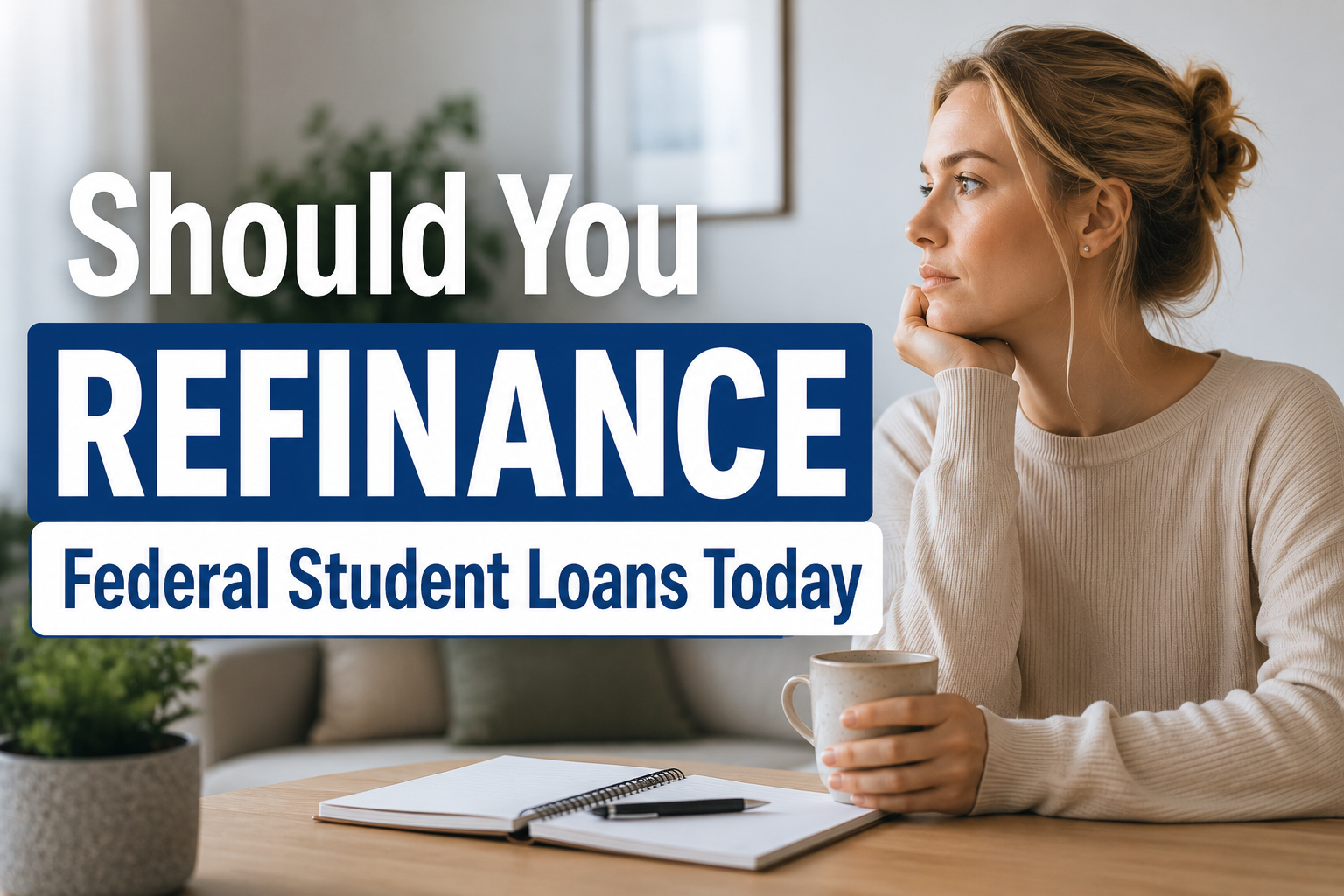
Refinancing federal student loans can help qualified borrowers lower their interest rates, reduce monthly payments, or simplify repayment. But refinancing is not the right move for everyone.
When you refinance federal student loans, you replace them with a private student loan through a bank, credit union, or online lender. Once that happens, your federal loans are paid off and you permanently lose access to federal repayment programs and borrower protections.
That tradeoff matters even more in 2026 as federal repayment programs continue evolving.
Before refinancing, borrowers should carefully compare interest savings against the value of federal benefits they may need in the future.
Student loan refinancing involves taking out a new private loan to pay off existing student debt.
Borrowers typically refinance federal student loans to:
Unlike a federal Direct Consolidation Loan, refinancing moves your loans out of the federal system entirely.
That means refinanced loans are no longer eligible for federal repayment plans, forgiveness programs, or government hardship protections.
Student loan refinance rates have improved compared to the higher-rate environment borrowers experienced over the past several years.
Highly qualified borrowers may find fixed refinance rates starting below 5% from some lenders, while many approved borrowers receive rates between roughly 5.5% and 8%, depending on credit profile, income, and repayment term.
Your actual refinance rate depends on factors including:
Borrowers with strong financial profiles generally receive the best refinance offers.
Refinancing can provide meaningful financial benefits in the right situation.
One of the biggest reasons borrowers refinance is to secure a lower interest rate.
Reducing your rate may help you:
Even a small reduction in interest can create substantial long-term savings on large balances.
Refinancing can combine multiple federal and private loans into one new loan with a single monthly payment.
Some borrowers prefer the simplicity of managing one lender and one payment schedule.
Private lenders often offer repayment terms ranging from 5 to 20 years.
Shorter terms may help borrowers save on interest, while longer terms may reduce monthly payment amounts.
Many refinance lenders offer both fixed-rate and variable-rate loans.
Fixed rates stay the same throughout repayment, while variable rates can increase or decrease over time based on market conditions.
For borrowers seeking payment stability, fixed rates are often the preferred choice.
The disadvantages of refinancing federal loans are significant and should not be overlooked.
Refinancing federal loans into a private loan permanently removes access to federal income-driven repayment plans.
These plans can help borrowers lower payments during periods of reduced income or financial hardship.
Refinanced loans are not eligible for Public Service Loan Forgiveness.
Borrowers working for qualifying government or nonprofit employers should carefully evaluate PSLF eligibility before refinancing federal debt.
Federal student loans provide protections that private lenders may not offer, including:
Private lenders may offer temporary hardship assistance, but policies vary by lender.
Federal student loan policies continue changing over time.
Borrowers who refinance federal loans become ineligible for future federal relief initiatives tied to federally held student loans.
Refinancing may be worth considering for borrowers who:
Borrowers with high income and strong financial stability often benefit most from refinancing.
Refinancing federal student loans may not be the best option if you:
In many cases, preserving federal protections can outweigh potential interest savings.
Whether refinancing makes sense today depends on your personal financial situation more than market timing alone.
Current refinance rates may create savings opportunities for borrowers with excellent credit and stable income. However, refinancing federal loans remains a permanent decision that removes important federal protections.
For some borrowers, refinancing can reduce borrowing costs and accelerate debt payoff.
For others, keeping federal loans may provide more valuable long-term flexibility.
In some situations, a hybrid approach may make sense. Borrowers sometimes refinance private student loans while keeping federal loans in the federal system.
Carefully compare lender offers, repayment goals, and the value of federal protections before making a final decision.
Refinancing federal student loans is a major financial decision that can have long-term consequences.
Before refinancing, review your eligibility for federal repayment programs, forgiveness options, and alternative repayment strategies.
Student Loan Tutor helps borrowers evaluate repayment options, forgiveness programs, and refinancing strategies based on their individual financial goals.
Book a custom student loan consultation today to determine whether refinancing federal student loans makes sense for your situation.
The strategy outlined in this article is designed to help you save on federal student loans and work towards forgiveness. Please be aware that the federal student loan landscape is subject to change. Adjustments to this strategy may be necessary with evolving regulations and policies, and by working with us, you can be confident that you are leveraging expert guidance to ensure you are always on the best path to maximize your student loan forgiveness.The contents of this article are the property of Student Loan Tutor. This message may contain an advertisement of a product or service. Student Loan Tutor does not render legal, tax or accounting advice. Accordingly, you and your attorneys and accountants are ultimately responsible for determining the legal, tax and accounting consequences of any suggestions offered herein. We recommend that you consult with your legal and tax advisers regarding this communication. Student Loan Tutor is not affiliated in any way with the US Department of Education. The estimates contained herein are based on estimates derived from the studentaid.gov federal student loan repayment calculator, taking into consideration repayment plans, federal student loan forgiveness, and tax implications associated with current tax estimates using TurboTax percentages for 2025. Student Loan Tutor accepts no liability for estimates contained herein as a borrower's life circumstances, final submitted documents, student loan law subsidies, loan forgiveness and tax implications can change at any time without any notice and many of these strategies are only recently starting to be realized due to long loan forgiveness terms. A number of factors could drastically change these figures, including but not limited to the following: using forbearance or deferment, missing a recertification, changes in law including but not limited poverty line index, spousal income, income documentation protocol, repayment plans, public service loan forgiveness qualifications, tax law, household size, additional loans, consolidations, refinancing and the COVID-19 Pandemic.
Looking for more information about how to navigate the terrain of student loans? Check out more of our most recent blog posts.
October 5, 2026
Lower student loan payments can provide short-term relief but may increase long-term costs. Understanding interest, repayment length, forgiveness eligibility, income, and total repayment can help borrowers choose strategically...

September 28, 2026
This article explores strategies for managing student loan debt while pursuing long-term forgiveness, including repayment plans, PSLF, income changes, extra payments, administrative requirements, and evaluating overall long-term repayment costs...
September 21, 2026
Strategic student loan repayment can help borrowers avoid overpaying by considering repayment plans, forgiveness, income changes, taxes, interest, autopay benefits, and long-term financial goals before making additional payments...


