Choosing the right student loan repayment plan in 2026 requires evaluating income, career path, and long-term goals instead of defaulting to the lowest payment. Regularly reviewing repayment options and prioritizing flexibility can help borrowers manage costs and avoid mistakes....
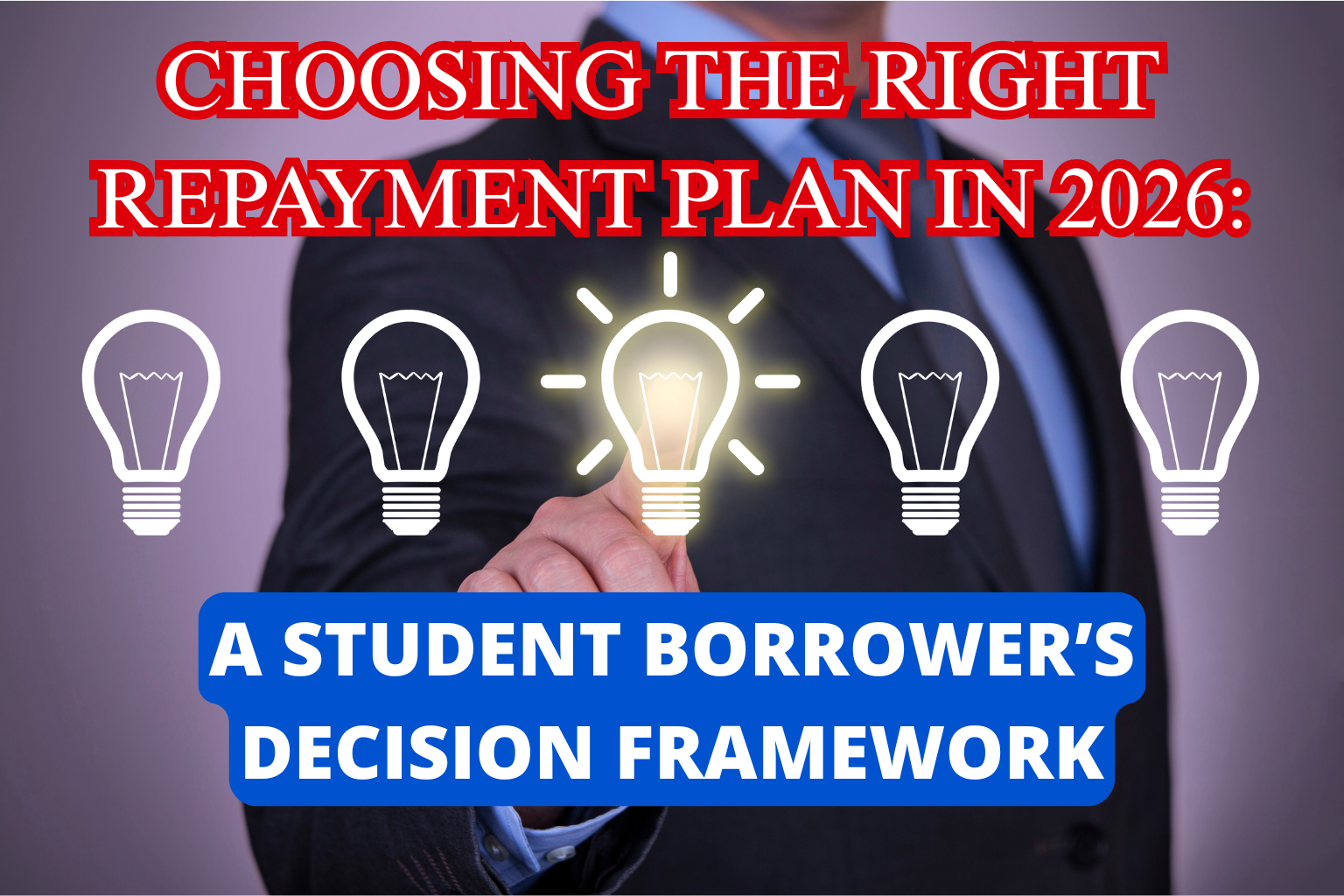
Choosing the right student loan repayment plan in 2026 is one of the most important financial decisions borrowers will make. With multiple repayment options available, and evolving rules around income-driven repayment, it’s no longer enough to pick the lowest payment or default to the standard plan. Instead, borrowers need a structured way to evaluate repayment plans based on income, career path, and long-term financial goals. This decision framework is designed to help borrowers make informed, compliant, and realistic choices about student loan repayment in 2026.
Student loan repayment is no longer a one-time decision. Changes in income, family size, employment, and federal program requirements mean that the “best” repayment plan today may not be the best one next year.
Borrowers who choose a plan without understanding how it interacts with their income and future goals often end up paying more than necessary, or missing out on protections they would otherwise qualify for.
A structured approach helps borrowers:
Before comparing plans, borrowers should be clear about what they want their repayment plan to achieve.
Common repayment goals include:
There is no single “best” plan for all borrowers. The right plan is the one that aligns with your financial priorities and risk tolerance.
Income stability plays a major role in determining which repayment plan makes the most sense.
Borrowers should consider:
General guidance:
Best for: Borrowers who can comfortably afford payments and want to eliminate debt efficiently. Starting July 1, 2026 this plan will range from 10-25 years based on the total Federal Student Loan balance.
Best for: Borrowers with high student loan balances relative to income or those needing payment flexibility.
In 2026, income-driven repayment remains a valuable option, but borrowers must stay current with annual income certification and plan requirements.
Loan forgiveness can be beneficial, but it is not automatic and requires long-term commitment.
Borrowers should assess:
A useful rule of thumb:
If a borrower can repay their loans in full within a relatively short time frame under a fixed plan, forgiveness strategies may offer limited benefit.
Before committing to a plan, borrowers should consider how it would hold up under less-than-ideal conditions:
A repayment plan should be sustainable not only in good years, but also during financial disruptions.
The most effective student loan repayment strategies allow room to adjust.
Borrowers should look for plans that:
Flexibility is especially important in an uncertain economic environment.
Choosing the right student loan repayment plan in 2026 is not a “set it and forget it” decision. Borrowers who review their repayment strategy regularly, and adjust when circumstances change, are better positioned to reduce stress, manage payments, and avoid costly mistakes. A thoughtful, informed repayment choice can make a significant difference in long-term financial health.
Choosing the right student loan repayment plan can feel overwhelming, especially as rules and options continue to change. A personalized review can help ensure your repayment strategy aligns with your income, goals, and long-term financial picture.
Student Loan Tutor works with borrowers to evaluate repayment options, explain tradeoffs, and create a plan that fits their unique situation. Whether you’re just entering repayment or reassessing your strategy for 2026 and beyond, professional guidance can help you move forward with confidence.
Take the next step by scheduling a consultation with Student Loan Tutor and get clarity on your student loan repayment options.
The strategy outlined in this article is designed to help you save on federal student loans and work towards forgiveness. Please be aware that the federal student loan landscape is subject to change. Adjustments to this strategy may be necessary with evolving regulations and policies, and by working with us, you can be confident that you are leveraging expert guidance to ensure you are always on the best path to maximize your student loan forgiveness.The contents of this article are the property of Student Loan Tutor. This message may contain an advertisement of a product or service. Student Loan Tutor does not render legal, tax or accounting advice. Accordingly, you and your attorneys and accountants are ultimately responsible for determining the legal, tax and accounting consequences of any suggestions offered herein. We recommend that you consult with your legal and tax advisers regarding this communication. Student Loan Tutor is not affiliated in any way with the US Department of Education. The estimates contained herein are based on estimates derived from the studentaid.gov federal student loan repayment calculator, taking into consideration repayment plans, federal student loan forgiveness, and tax implications associated with current tax estimates using TurboTax percentages for 2025. Student Loan Tutor accepts no liability for estimates contained herein as a borrower's life circumstances, final submitted documents, student loan law subsidies, loan forgiveness and tax implications can change at any time without any notice and many of these strategies are only recently starting to be realized due to long loan forgiveness terms. A number of factors could drastically change these figures, including but not limited to the following: using forbearance or deferment, missing a recertification, changes in law including but not limited poverty line index, spousal income, income documentation protocol, repayment plans, public service loan forgiveness qualifications, tax law, household size, additional loans, consolidations, refinancing and the COVID-19 Pandemic.
Looking for more information about how to navigate the terrain of student loans? Check out more of our most recent blog posts.
October 5, 2026
Lower student loan payments can provide short-term relief but may increase long-term costs. Understanding interest, repayment length, forgiveness eligibility, income, and total repayment can help borrowers choose strategically...
September 28, 2026
This article explores strategies for managing student loan debt while pursuing long-term forgiveness, including repayment plans, PSLF, income changes, extra payments, administrative requirements, and evaluating overall long-term repayment costs...
September 21, 2026
Strategic student loan repayment can help borrowers avoid overpaying by considering repayment plans, forgiveness, income changes, taxes, interest, autopay benefits, and long-term financial goals before making additional payments...


